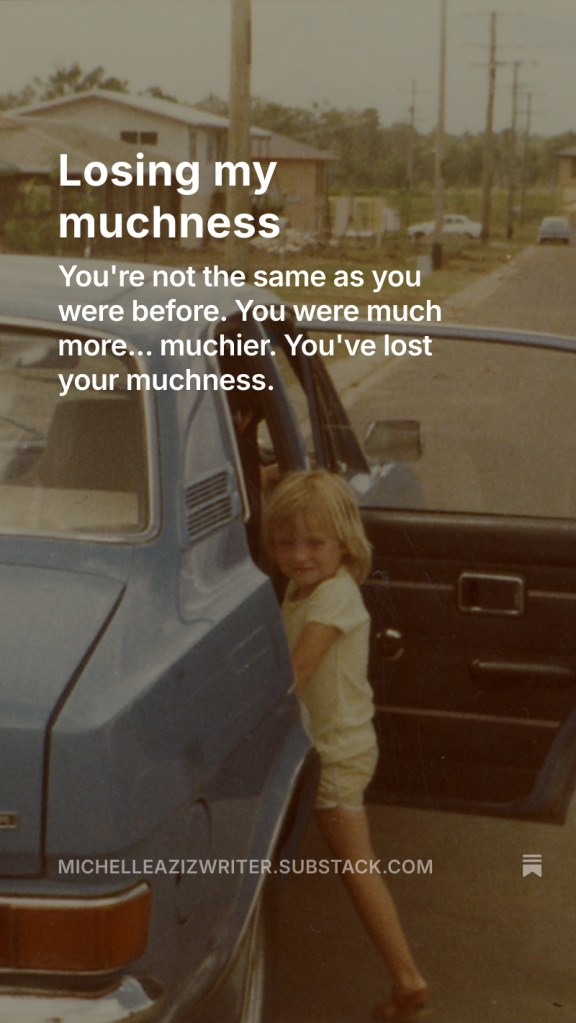
You’re not the same as you were before. You were much more… muchier. You’ve lost your muchness.
I don’t remember a time when I didn’t want to be a writer. The urge was stitched into me from the very beginning, like a quiet stubborn thread woven through my childhood. Other kids played with dolls, but my early life was full of boys – brothers, cousins, boys next door – all dirty knees and skateboards, so I played with words instead. I set up an office in the laundry overlooking the dusty bushland, plastic orange chair squeezed beside Mum’s washing machine with matching plastic desk neatly stacked with paper and pens. I sat for hours at a time in the sweltering heat dreaming of the day when I would write a book so devastating that it changed people’s lives.
In primary school my teachers told me I was special. They used that word – special – and I shyly tucked my head so they couldn’t see my cheeks glowing with pride. You should be a writer, they all told me, after reading my essays where I waxed lyrical about injustices with the ferocity of a ten year old who thought she knew everything. I won spelling competitions without really trying, and public speaking came naturally to me. I performed cheeky poems about my teachers, and delivered impassioned speeches about the suffragettes as if I had lived their fight myself.
I longed to help people, to inspire, to teach. I wanted to use my words to make people feel the way I did when my favourite character died, and I was inconsolable for a week, crying over fictional friends who felt so real to me. Writing felt like it could be may way through the world, the way I could stretch beyond the edges of my small town and say: I was here. I mattered.
But somewhere along the way, I lost it. I lost my spark, my ‘muchness’, as the Mad Hatter would say. I lost my largeness of spirit, the too-muchness that children are born with before the world starts telling them to sit down, lower their voice, and be realistic. I don’t remember when exactly it happened, only that little by little, I shrank. I tucked myself into corners, made myself smaller.
The confidence that had once been as natural as breathing turned brittle, fragile. I began to fear failure in a way I never had as a child. At school failure had been a dare, a challenge. By adulthood, it became something monstrous, a shadow hovering at the edge of every decision. So I played it safe. I took jobs that were fine, that didn’t stretch me too far, jobs that allowed me to hide in mediocrity. I coasted along, never trying too hard, never daring too much. “Good enough” became my motto, thought inside it felt anything but good. I packed away my dreams, storing them in some unreachable box in the bottom of my heart, convincing myself that I’d take them out again one day.
Fear became my closest companion. It started as hesitation – tiny doubts, second guessing. Then it grew. Panic attacks gripped me most mornings, so severe I sometimes thought I might die before leaving the house. I prayed to God every day to give me the strength to endure the hour-long train commute into the city, then panicked for the rest of the day about the train ride home. My stomach churned constantly with anxiety, waiting for disaster to fall from the sky. My world shrank to fit my fear.
I knew that something had to change, that my mental health was getting worse, and it was getting more difficult to hide from the outside world. I had this terrible feeling that I was moving towards a certain death, every day ticked off the calendar was a day closer to the end of my life. The pressure building inside my mind, my heart, my brain was immense. I would wake in the middle of the night unable to breathe, jaw clenched shut, scared to death of the nothingness stretched in front of me.
I wanted to do so many things, but I was drifting into apathy. Any flicker of hope or ambition that dared to stir inside me was quickly extinguished. Fear and inertia made sure of that. Whenever I thought maybe, just maybe, I could try something new, do something daring, my mind would clamp down hard: no, too risky, too late, too much. So I let myself grow smaller and smaller, until I was almost invisible, even to myself.
And then one day everything changed.
The day I was told I had cancer, the world split into two. Before and after.
It was the kind of sentence you never expect to hear applied to you, only to other people. But there it was, spoken plainly, like a fact that had been waiting in the wings all along. In that moment, all the shrinking, all the hiding, all the ways that I had made myself small – it all seemed so foolish, so fragile. But I also felt a strange sense of relief, an a-ha moment, here it was finally, the reckoning I had been so afraid of for years. The worst had finally happened. Now what was I going to do about it?
Cancer was not the beginning of my story, but it was the catalyst that forced me to confront how far I had drifted from myself. It jolted me awake, reminding me of the girl who once stood on school stages with poems and speeches, fearless and alive. The girl who had opinions too big for her body, who wanted to set the world alight with her words.
The girl hadn’t vanished completely. She had only been buried, waiting.

 healing through words
Leave a comment