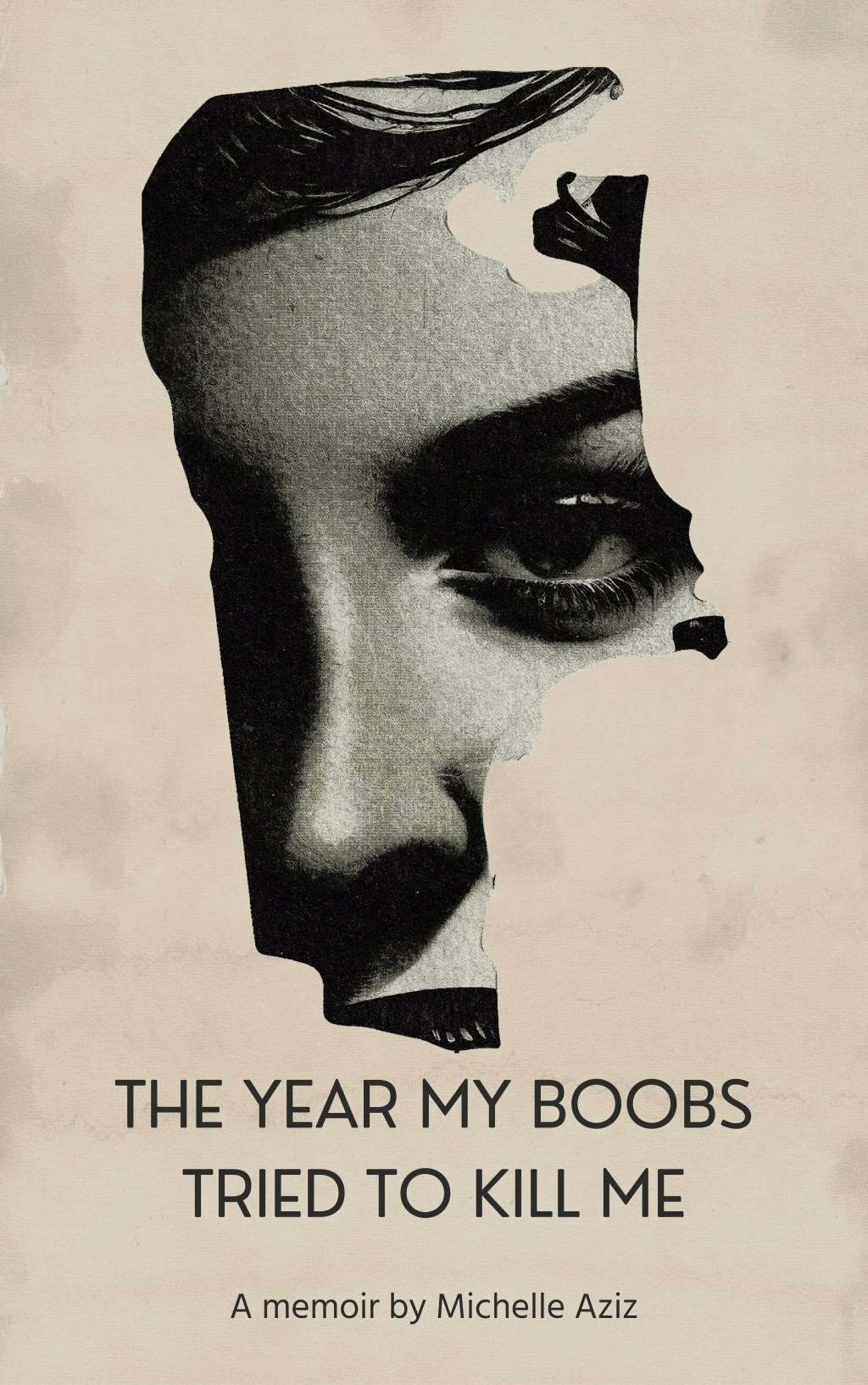
I made it through the first twelve weeks of chemotherapy one day at a time, though even that feels like too generous a phrasing now. There were no heroic dawns or moments of gritty resilience. There was only the slow, methodical disintegration of my body, the chemicals burning their way through me, and the stubborn part of my mind that kept whispering: Just one more round. Just get through the next one.
By Week Five, my hair had completely given up. At first, it fell in clumps onto my pillow, the shower floor, my lap. Then the clumps became strands, and the strands became nothing at all, just smooth, bare skin that glowed under the bathroom light. I would stand there, running my hands over my head, shocked at the person reflecting back at me. My eyebrows and eyelashes were the last holdouts, dangling by a literal thread – as though even they were fighting to stay, to hold some version of me on my face. Every morning, I would check the mirror to see if the eyelashes were still there. Most days, a few would be hanging on, sideways and defiant, before eventually surrendering to the pillow or the bathroom sink.
What scared me more than the hair loss was the swelling. My whole body puffed up like I’d been stung by a hive of invisible bees. My face grew twice its size from the steroids, my cheeks ballooning outwards, red and fevered. I couldn’t close my hands properly; the skin on the back of them felt stretched to its limit. My feet were so swollen that walking became a negotiation. And then, worryingly, my breathing started to tighten, each inhale shallow, like someone had placed a hand on my chest and pressed down.
Day Seven after each infusion was supposed to be my recovery day – the day the fog lifted, the day I would slowly claw back pieces of myself before the next hit. But with each round, Day Seven became harder to reach. My body was losing the race. By Week Ten, Day Seven felt like Day One over again. The cumulative effect of the chemicals meant I was rolling downhill faster than I could stand up.
Some nights, I didn’t sleep at all. I would lie in bed, wide awake, staring into the darkness as technicolour hallucinations swirled across the room. Neon shapes, pulsing lights, kaleidoscope patterns. The steroids were doing something to my brain, something I was too frightened to admit to anyone. My tongue felt too big for my mouth, swollen and rubbery, and my limbs would splay out awkwardly across the bed, trying to find some position that didn’t hurt. My cheeks blazed hot red, as though on fire, and I’d drift in and out of consciousness, waking suddenly to find my husband standing over me, checking my pulse with two trembling fingers.
“I’m fine,” I’d whisper, and he would nod, but I could see the fear etched into him, the heaviness in his shoulders. I hated that most of all – how much fear my illness put into the people I loved.
One morning, during one of my routine panicked self-checks – because every new sensation became a threat – I found a hard lump in my armpit. My heart froze in my chest. My mind immediately went to the worst-case scenario: The chemo hasn’t worked. The cancer has spread. This is it. I called the hospital and they rushed me in for an ultrasound.
My oncologist’s eyes gave her away. I could see her calculating, preparing, bracing herself for the possibility of bad news. For the first time since meeting her, she looked worried. And that terrified me more than the lump itself.
In the ultrasound room, I scanned the technician’s face as he moved the wand across my skin. Technicians always try to stay neutral, but fear heightens everything: the angle of their mouth, the pause of a breath, the slowing of their movements. I was desperate for any sign that I wasn’t dying.
He must have seen the panic in my eyes – this bald, swollen, ghostly woman lying on the table, clinging to hope like a lifeline. He lowered his voice and said, “Look, I can’t officially tell you anything… but unofficially? I can’t see anything.” Then he winked, an actual wink, as if tossing me a life raft in the middle of a storm.
When I floated – because that’s the only word for it – back to my oncologist’s office, she confirmed it. Not only was the lump nothing to worry about, but the tumour in my breast had shrunk to almost nothing. The chemo had done its job.
I felt relief wash over me so powerfully I nearly cried. But I remained stoic. I always did, sitting in that room. For some bizarre reason, I wanted her to think I was strong. I treated chemotherapy like an exam, and I wanted to be the Grade A student. I wanted her to see that she didn’t have to worry about me, that I could handle this, that I was competent even while falling apart. Ridiculous, I know – but vulnerability was too frightening, too exposed. Stoicism felt like the only thing I could still control.
My moment of relief didn’t last long. Because next came the final round of chemotherapy: the dreaded Red Devil.
Every cancer patient knows the stories. Some whisper them like legends; others speak plainly: Most people don’t finish it. It’s the most toxic chemo there is. The official name is doxorubicin, part of the anthracycline family, and the drug is literally bright red – so red it looks unnatural. Nurses call it the “Red Devil” because it can cause permanent heart damage, organ failure, and in rare cases, death. It’s so corrosive it can blister your skin if it leaks from the vein. You’re monitored the entire infusion for signs of collapse.
On the morning of my first dose in June 2024, I was alone in the house, waiting for my family to pick me up. I couldn’t sit still. I ran from room to room, cleaning frantically, wiping benches that were already clean, folding clothes that didn’t need folding – as if tidying my environment could somehow tidy the chaos inside my body.
When my brother finally walked through the door, I broke. Tears streamed down my face before I even realised I was crying. I shook violently, terrified but resolute. There was no choice. I would open my shirt, expose the port embedded in my chest, and let them push the Red Devil straight into my bloodstream, straight towards my heart.
In the chemo suite, they brought out the small vial. It really was bright red – almost fluorescent – and it took only fifteen minutes to infuse. Several nurses hovered around me, watching like hawks, ready to hit emergency buttons if my body decided enough was enough.
But I didn’t collapse. When the infusion finished, I stood up on unsteady legs, walked out of the hospital, and went home.
The next day, I felt like a zombie. My port looked wrong – angry and bruised – and over the next forty-eight hours, the skin around it grew hot, red, and swollen. I kept trying to convince myself it was nothing. That I just needed rest. That I couldn’t possibly handle another complication.
By Monday morning, I couldn’t deny it any longer. The port was infected.
I woke at 5am. I didn’t tell my husband or my son; I didn’t want to alarm them. Instead, I called my parents and asked them to take me to the emergency department. I honestly thought I would be given antibiotics and sent home. A quick fix. An inconvenience.
But when the triage nurse took one look at the port, she recoiled. Within minutes, I was ushered straight to the back of ED. Bloods were taken. Nurses and doctors kept coming over, peering at the infected site with expressions that hovered somewhere between concern and fascination. No one wanted to touch it. That’s when I understood: this was serious.
I lay in a bed in the far back corner of ED for eight hours, listening to the sounds of the ward – the beeping monitors, the shuffling feet, the overhead announcements – waiting for a room upstairs. Every so often, a nurse would stop by and check that I was still awake, still lucid, still with them. I wasn’t going anywhere. Not that day. Not any time soon.
Lying there, bald, swollen, exhausted to the marrow, I realised just how thin the line was between coping and collapsing. Between making it through the treatment and being consumed by it. I had been so focused on being strong, so determined to show everyone—my husband, my oncologist, my family—that I was handling it, that I forgot the truth:
No one can “handle” chemotherapy. You just survive it. Barely, sometimes. But I was still here. And for now, that was enough.


 healing through words
Leave a comment